
a self-help guide to STOP reading self-help guides (the LAST self-help guide you will ever need)
J. Bradley Minnick is a writer, public radio host and producer, and a Professor of English at the University of Arkansas at Little Rock. His books The Bankrupt Circus & Other Misadventures and The Book of Why were published through Silent Clamor Press.
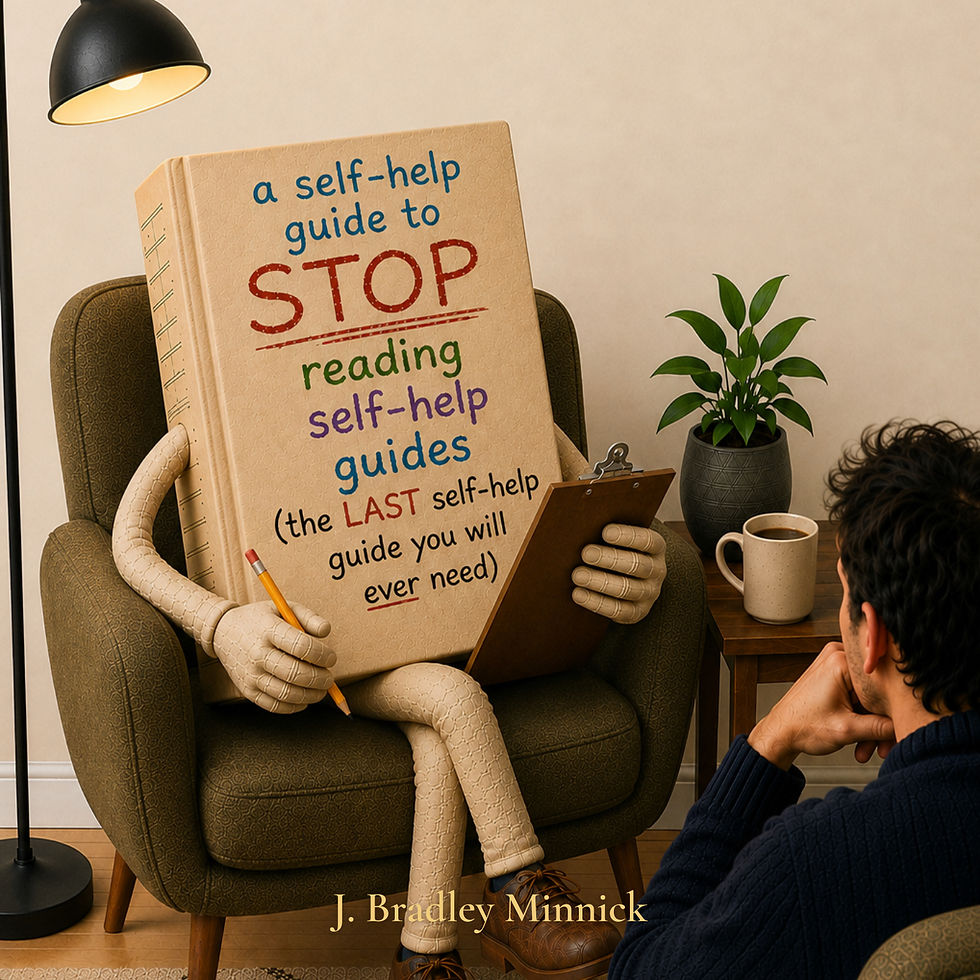
As you put this down, you call attention to the self who feels the need to put this down.
It’s a question of audience.
It has always been a question of audience.
You pick up your journal from the floor—a self-help guide to STOP reading self-help guides (the LAST self-help guide you will ever need)—the title scribbled in crayon on its cover—and accidentally bump your thumb against the bottom of the bedframe. The bruise that is left is red.
Yesterday, you crossed your legs under the kitchen table while you sat writing a self-help guide and bumped your left kneecap on the crossed-table legs underneath.
The irony is not lost on you.
The table is white and Formica. Your legs are thin and weak. The table’s legs are metal and old, as is the bedframe and all are rusted.
You worry about tetanus. You worry about lockjaw. You worry about losing feeling in your thumbs and knees. Headaches become brain tumors; stomachaches, stomach cancer; heart palpitations, death marches—has your pulse gone missing? God forbid if suddenly you were to piss blood.
When you re-read portions of a self-help guide on the phone to friends, the sound of your own voice literally hurts your left ear, plugs it up so much that you have to lie on your aching ear until the warmth of the pillow resuscitates it.
You worry about going deaf. You worry about Q-Tips going in too far. You wonder when you go deaf if you will still be able to sense the cadences of language when people speak to you. You seriously doubt it. At least you could still write. There were plenty of deaf writers: good ones: Donald Harington; Borges—no he was blind. Beethoven composed symphonies.
While lying on your aching left ear, you think about going back through a self-help guide to STOP reading self-help guides and locating where truth has gone astray. While lying on your aching left ear and nursing your bruised thumb and left kneecap, you realize that whether you believe in writer’s block or not, you are not writing. Doing so would simply hurt too much.
Your beautiful wife—let’s call her Appalachia—her parents are these real solid hippies who still live in Pump Log Hollow, Tennessee—says that people are always hurting themselves in ways large and small, mostly every day. Appalachia says that she will only answer the same question about the state of your health five times a day—no more! After five queries she yells, “Help your fucking self.” You attribute her comments to unresolved anger, or her period—if you broach the period thing, Appalachia yells, “I’ll write that down in my own Here Comes the Abuse Manual! (I Don’t Have an Anger Problem, I Have a Problem with You!)”
Appalachia’s Abuse Manual! is not at all like a self-help guide. Sometimes you wonder if her Abuse Manual! is even a real self-help book. You worry about reality. You worry about unreality. You worry about clichés about wisdom and wonder and if you possess enough of each to know the difference.
You can’t lie. You fall down flat in the doorways of your fibs: your face beat red, your tongue a-stutter, your lips burbling, your voice a-tremble—when you prevaricate, you sound like a re-threaded cassette tape played backwards at an alarmingly slow speed. You don’t even try to lie anymore—especially to Appalachia.
Appalachia need not worry about you ever cheating on her; in her Abuse Manual! she writes, “Were he to break his vows, he’d be walking funny for the rest of his life!” With Appalachia there’s a lot of tough talk, not to mention tough language, not to mention tough love. “I need to be nurtured,” you say. “You’re a grown man,” Appalachia says. “YOU need to nurture yourself.”
Truth is, if you are honest with yourself, you don’t like to be touched, and you don’t like to touch people. Handshakes make you cringe; hard handshakes are the worst; limp handshakes make you feel dirty like you need a shower.
Over the phone, you tell your mother that you sometimes wonder if all this worry is worth the effort. Your mother says that when you are worrying you’re not doing anything. You argue with her and tell her that you are doing something. “I am doing something,” you say. “I am worrying. Thought is action.” “It won’t make any difference,” she says.
Your mother would never say this directly to you, but you sense she doesn’t even like to listen to you anymore, but, unlike Appalachia, she continues to listen because she’s your mother. And, she continues to answer your health questions, six, seven, eight times a day. “A mother’s love is never lost—even with repetition”; you sentimentally write this down in your a self-help guide.
Daily, you drink a bottle of stress and eat your weight in anxiety. Nightly, you are pain personified. By breakfast, you have reset and imagine that you have a high IQ. At lunch, you take an IQ test. By dinner, you don’t believe in the validity of IQ tests.
You have taken to frequenting the self-help aisle of BookWorld—your local big box bookstore. Appalachia refuses to set foot in BookWorld. She says BookWorld doesn’t provide even half the experience of BookWorm—your town’s local independent bookstore.
The self-help aisle of BookWorld has become your world. Self-help—to help one’s self, but through a book. The aisle really should be called OTHER HELP BOOKS, but when you submit the suggestion card to the long-suffering research assistant, who sorts through and catalogs suggestion cards, you’re certain she skips right over your suggestion.
Didn’t the suggestion card say “Help”? That’s all you really want: to help and be helped. Help will bring joy, efficacy, and make meaning of your life: and, with a self-help guide you can help yourself and others. After all, you think why did God put Adam and Eve on the planet if not to help each other and, of course, to eradicate snakes?
You curate your phobia catalogue daily (snakes, spiders, gnats, moths, lizards, bears, raccoons, one-eyed safari animals, dogs that return tennis balls to baby carriages, and fornicating squirrels). You have squirrel fornication nightmares: they don’t seem to care that you catch them in the act but instead stare and say, “Excuse me!” in thought bubbles; you refuse to touch reptiles or sugar gliders or chameleons or horned toads (especially horned toads, although you can’t remember the last time you saw a horned toad); and, did you mention that you are plagued by science fiction dreams?
In your a self-help guide, you catalogue daily your obsessions (handwashing, handwringing, arthritis—from cracking your knuckles to see if they will continue cracking to distasteful smells like burnt toast—from smoking vegetables, vinegar, fresh paint to all disinfectants, scented soaps, scented candles, deodorants and smelly stickers).
During your visits, your mother uses a lot of vinegar to cook and clean with. (Is she angry with you? Is she trying to drive you away? Does the dryer sheet wrapped cravat-like around her neck signify something?)
You call helplines even though you know their limitations. Kind voices make you feel like you are wasting their time, yet remain sympathetic. Everything is like this you realize: 10 good things, 10 bad things. Change = death; death = change.
This is not funny. This is not funny at all. You couldn’t make this shit up, but people think you do.
So, okay, you are two pages into writing a self-help guide to STOP reading self-help guides (the LAST self-help guide you will ever need). You have followed all of the advice in the craft books that are both about writing and not really about writing at all. You’ve established background; you are audience-aware; you’ve showed, not telled; there is a well-earned pathos—maybe even some empathy—most probably disgust. You are both reliable and unreliable; you are both someone your reader wants to spend time with, and not; you have written your way into your reader’s interest, and you have written your way out of it. You have been careful with explanation, analysis and its analogue, finding your way like a blind man to discovery and decision. And, you’ve made lots of lists. Your current motto is: “We only know someone by the lists they make.”
This is how a self-help guide to STOP reading self-help guides (the LAST self-help guide you will ever need) begins:
Let’s start with a few basic not-affirmations, and let’s read aloud shall we? (Apply to self and read aloud as needed):
You will not stop at BookWorld on the way home from work.
You will not spend all of your money on self-help books.
You will not put all of your self-help books out on the coffee table for everyone to see, hoping but afraid someone will visit.
You will not be ashamed of affirmations!
You will not be ashamed of self-help.
Now some “will ya” affirmations:
You will stop looking to others for help about a self they can’t possibly know.
You will stop reading highlighted passages in previously owned self-help books to your friends over the phone. (NOTE: THIS ANNOYS THEM.)
You will not put off today what you plan not to do tomorrow.
You will stop underlining significant passages in self-help books with different colored markers to designate how many times you have read them. You will stop creating affirmation lists.
You will get rid of all of the self-help books that you don’t read in a year. You will donate them to the richest condominium building you can find. (One with floor to ceiling windows and pigeon problems on its parking decks.)
Most importantly, you will begin healing immediately!
Before you can begin writing page 2 in a self-help guide, you tell Appalachia that you need a way to understand how to begin writing page 2. You say: “Every self-help writer needs to begin a page 2, even if that beginning is intended to help the self that is other.” Appalachia suggests that you ignore your own self-help advice and says, “Everything to help yourself is already within you.”
This is how page 2 of a self-help guide to STOP reading self-help guides (the LAST self help guide you will ever need) begins:
The self is over-rated.
Everyone falls in love with his/her own ego.
Emotional intelligence does not necessarily lead to self-awareness.
Hunches often lead to crying.
“Follow your bliss” often leads to STDs.
There are too many self-help books on the shelves of BookWorld where there is everything and nothing that you want.
Informed choices about which self-help reading experiences are worth pursuing are not necessarily informed.
The only thing to fear is that someone has already written a self-help guide to STOP reading self-help guides (the LAST self-help guide you will ever need).
If you are reading this list, you are wasting time:
a. Why do you keep reading this list?
b. Why are you still reading this list?
Now, go out and help yourself.
A sealed envelope of pages 1-2 of a self-help guide arrives in the mail. You sent them to yourself for copyright purposes.
NOTE: Appalachia says, “THERE SHOULD BE PICTURE OF YOU ON THE COVER OF THE BOOK.” Sometimes Appalachia can be just plain mean.
Appalachia says you should just slip a copy of your two-page guide in between A Self-Help Guide to Quintessential Love and A Self-Help Guide to Satisfaction in Love-Making on the sagging BookWorld self-help shelf. “Just put the free-standing pages of a self-help guide on the shelf and hang out in the aisle and see if anyone picks them up. Or,” she says sarcastically, “you should hang around BookWorld reading your own guide aloud. I’m not being mean. Rest assured, promoting books is all about self-promotion.”
Appalachia says, “Readers don’t come to see an author, but to hear him. Listen: You think it’s all about the self, but if no one reads the guide, no one will be helped, including yourself. Therefore, you should change your title and call it Promoting Self-Help.”
You place one copy of the first two pages of your book (original title) on the shelf at BookWorld and fade into and among the math textbooks and wait for an hour, pretending you’re a speed reader.
It doesn’t appear that anyone is drawn to a self-help guide to STOP reading self-help guides (the LAST self-help guide you will ever need). The self-help junkies seem, instead, drawn to diet books or books on identity theory or books about sex.
You imagine a self-help guide is destined to sit on this shelf in BookWorld until the Self-help Revolution shelf gives way to a Self-loathing shelf. (Isn’t that the way it always is?)
Sex sells after all and self-loathing is always in fashion.
Wait! It is Appalachia who now holds the only two pages of a self-help guide to STOP reading self-help guides (the LAST self-help guide you will ever need) and begins reading it. It is she who stands right there in the middle of BookWorld, a store, she says she detests, reading; gesticulating; pointing and laughing. Look: she is rolling around on the floor holding your guide. She is producing peals of laughter; she is producing quite a stir; the research assistant comes to help.
“Perhaps security should be called?” the research assistant says.
Appalachia says: “I am a lapsed nun.”
“Call the manager,” a teenaged boy shouts.
“Call that lady a funny fit,” a little girl says.
“I call that laughing,” a blue hair says.
“There are free-flowing pages in her hand,” they all say, “BEWARE!”
“I’m-a-doctor” shows up, and he’s hard-pressed to pry a self-help guide out of Appalachia’s hands: “She just won’t let go. We need an expert—a reading expert,” the doctor proclaims. “I’m a reading expert,” a schoolmarm wearing wool socks for shoes says. “It’s a top-down-bottom-up problem. I’ve seen this before; it may be a hyper-phonetic condition. Here, clap out the syllables as I read them.”
The manager yells, “Don’t use profanity. Bookworld is a family store.” And, to his staff: “Why is everyone standing around?” And to the patrons, “We’ve got books and magazines and coffee and cookies.” And to everyone, “There’s too much standing around, and I’m an expert on standing around. If you want to stand around, stand around in the check-out line. And for God’s sake, get this laughing woman some help.”
Book security helps Appalachia to her feet, escorts her to Check-Out, where the check-out person forgets to demagnetize her and when she runs out the door, she sets off the alarm.
Book Security jumps in the Book Mobile and rides around the BookWorld parking lot looking for her; every now and then they hear peals of laughter. You love your wife, you do, but she is about as addle-brained as you are.
Suddenly, a young woman with good hair picks up the two pages of a self-help guide to STOP reading self-help guides (the LAST self-help guide you will ever need) from the floor and begins reading. She’s actually reading, and moreover is deep in concentration, nonplussed by the sirens and lights outside.
As you put this down, you call attention to the self who feels the need to put this down.
It’s a question of audience.
It has always been a question of audience.


Comments